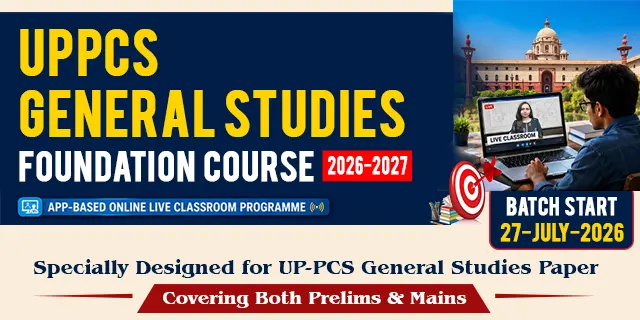
UP-PCS GENERAL STUDIES Foundation Course Live Classroom Programme (2026–2027)
The UP-PCS General Studies (Prelims-cum-Mains) Programme is a fully integrated course. Our mission is to democratize quality education for State PCS aspirants.
Classes will be conducted regularly through the Chronicle IAS Interactive App.

USPs of the Programme
Our live, interactive classes focus on conceptual clarity, analytical depth, and current relevance, ensuring comprehensive coverage of General Studies and Current Affairs as per the latest exam requirements.
- Classes are conducted in Hinglish medium of instruction—with board content in English, while concepts, terms, and theories are explained in Hindi for better understanding.
- For effective pedagogy, we use tables, flowcharts, diagrams, images, and maps to enhance learning.
- The programme also includes expert-led personalized mentorship and dedicated doubt-solving sessions.
- All live classes, class notes, board content, and model MCQ PDFs are available for download.
Doubt-solving Sessions: After every class, there is doubt solving session. Apart from this, weekly doubt clearing session can be organized on individual student request.
Mentorship: Dedicated expert faculty guidance and continuous personalized mentorship throughout the preparation journey.
Special Classes for GS Paper V & VI: Integrated Prelims & Mains state special classes with structured notes to build a solid base for General Studies Papers V and VI.
Daily Practice Classes: Model MCQs based on daily classes with 3600 analysis & discussion with Mains Practice Questions along with Answer Writing Technique (PQAWT) from the beginning.
Tests & Practice Assessments for Prelims: Sectional & Mock practice questions with discussion.
Tests & Practice Assessments for Mains: Sectional & Mock practice questions with individual evaluation, feedback & model answers.
Study Material: Authentic, updated study material based on NCERTs and standard references, including 27 printed Prelims & Mains books in Hindi and English.
Current Affairs Coverage: Dedicated separate, focused classes to ensure comprehensive and up-to-date understanding of current events.
CSAT: Updated and authentic foundation classes and notes specifically designed and aligned with the latest UP-PCS syllabus and exam trends.Programme Details
General Studies Focused Classess
General Studies
- Indian Polity & Constitution
- India & World Geography
- General Science
- Indian Economy
- Ecology & Environment
- History of India
- CSAT
- UP Special Prelims Exclusive Classes
- Current Affairs
Mains Exclusive
- World History
- India After Independence
- Disaster Management
- Internal Security
- International Relations
- Science & Technology
- Indian Society, Social Justice & Social Issues
- Governance
- Socio-Economic Development
- Ethics
- Exam-Specific Current Affairs
- Special Classes for GS Paper V
- Special Classes for GS Paper VI
- General Hindi
- Essay
Tests & Practices
Prelims Exclusive
Tests & Practices
- 200 Chapter Wise Class Tests
- 24 Years (2001-2025) Chapter-wise PYQs
- Monthly Current Affairs Practice Tests
Mock Test Series (45 Tests)
- 10 GS Paper-I Mock Tests
- 5 GS Paper-II (CSAT) MOCK Tests
- 30 Sectional Tests
Mains Exclusive
- GS Practice Questions (Paper I to VI)
- Ethics Case Study Practice
- Essay Practice Questions
- UP Special Practice Questions
- General Hindi Tests
Additional Support
Digital Support
- Faculty-Prepared Class Notes
- Recorded Lectures of Live Classes
- Prelims Practice Questions
- Mains Practice Questions
- Class Board PDFs
Resource Samples
- Demo Class Videos
- Class Board PDFs
- Class Notes PDFs
- Model MCQs PDFs
- Study Material (Books in PDF Format)
- Topic-wise PYQs
Orientation Classes
- Micro-level, Subject-wise Syllabus Discussion
- Exam Strategy & PYQ Analysis
- Current Affairs Preparation Strategy
Current Affairs Support
- Monthly Current Affairs Magazine
- Daily Current Affairs Notes
- Daily Current Affairs MCQs
Printed Study Material
Along with this course, you will receive 27 comprehensive books that are updated, reliable, and exam-focused. These books are designed to be concise yet comprehensive, strictly aligned with the latest syllabus and examination pattern.
This set of twenty-seven books, published by Chronicle Publications, has been carefully prepared using content from Old & New NCERTs (Classes 6 to 12), along with IGNOU, NIOS, State Board materials, and other standard textbooks.
Note: Subject-wise books will be available before the commencement of the online live classes.
Printed Books
- History of India
- Indian Polity
- Indian Geography
- World Geography
- Indian Economy
- Environment & Ecology
- General Science
- Art & Culture
- Ethics
- Governance
- World History
- Indian National Movement With India After Independence
- Disaster Management
- Internal Security
- International Relations
- Science & Technology
- Indian Society
- Social Justice
- Social Issues
- Socio-Economic Development
State-specific Books
- 10 Years Prelims Solved Papers (PYQs)
- UP Special Book for Prelims Examination
- UP Special (Mains) – Paper V
- UP Special (Mains) – Paper VI
- Compulsory Hindi Paper
- Essay (Including State-specific Topics)
- 10 Years Mains Solved Papers (PYQs)
Batch, Schedule & Fee Details
Fee Details
- Complete Course Fee: 14999 including GST (EMI Available)
Download our Chronicle IAS Learning App
FAQs:
- UP-PCS Foundation Course
- UP-PCS EXAM
It is natural for aspirants to have several questions before enrolling in a new course. Here, some of the most important queries about Chronicle IAS’s UP-PCS Foundation Course are answered through a conversation between Chronicle IAS and an aspirant.
Aspirant: Sir, what is Chronicle IAS’s UP-PCS Foundation Course?
Chronicle: It is a 12-month integrated programme specially designed for aspirants preparing for the UP-PCS 2026–2027 examinations.
The course comprises approximately 600+ hours of comprehensive instruction. Classes are conducted according to a structured schedule, ensuring that every subject is covered systematically, with focused and exam-oriented guidance.
Aspirant: Sir, what are the key features of this course? What do we get after enrolling?
Chronicle: Let's take a quick look at the major highlights of the course:
- Course Duration: 12 months (UP-PCS 2026–2027 Batch)
- Class Schedule: Six days a week, 3:00 PM to 6:00 PM
- Daily Learning: 2 Sessions (2+1 hours)
- Total Teaching Hours: 600+ hours
- Study Material: 27 printed books covering all General Studies subjects (Prelims & Mains), Uttar Pradesh Special (Prelims and Papers V & VI), and Compulsory Hindi, Essay, and Previous Year Prelims & Mains Questions (PYQs)
- Test Programme: Daily subject-wise tests, weekly full-length tests, and monthly revision tests
- Integrated Preparation: Comprehensive preparation for Prelims, Mains, Essay, Hindi, and Interview
- Digital Support: A class synopsis is uploaded to the App and Website after every class
- Answer Writing Practice: Regular answer-writing sessions, detailed evaluation, and model answers
- Mentorship: Personalised mentorship from the experienced faculty of Chronicle IAS
In short, you become part of a complete, step-by-step learning ecosystem, where every class, every test, and every study resource takes you one step closer to success.
Aspirant: Sir, what is the core philosophy behind this Foundation Course?
Chronicle: Friends, the vision of Chronicle IAS is very clear—
Our goal is not merely to complete the syllabus, but to develop an exam-ready mindset.
The entire philosophy of this Foundation Course is built on three pillars:
1. Conceptual Clarity
We begin every subject with its fundamental concepts so that you don't simply memorise facts—you understand the logic behind them.
2. Continuity in Learning
To ensure that your preparation never loses momentum, classes, synopses, tests, and revision are all integrated into a well-planned learning cycle.
3. Integrated Preparation for Prelims and Mains
We do not prepare you for the Prelims and Mains separately because their syllabi largely overlap. The real difference lies in the style of questions asked and the way answers are presented.
That is why, in the Chronicle IAS’s Foundation Course, every subject is taught with both Prelims-oriented factual preparation and the analytical approach required for the Mains.
In other words, study once and prepare for both stages simultaneously.
Aspirant: Sir, what is the ultimate objective of this course?
Chronicle: Our objective is absolutely clear—to help you become a successful UP-PCS Officer.
Chronicle IAS’s UP-PCS Foundation Course transforms scattered efforts into a structured, result-oriented preparation strategy.
Here, you don't just complete the syllabus—you also learn:
- How to study
- How to write
- How to present your knowledge effectively
When these three qualities develop together—
- Conceptual Clarity
- Consistency
- Confidence
—selection is no longer just a dream; it becomes an achievable reality.
So, if your target is UP-PCS 2026 or 2027, Chronicle IAS’s UP-PCS Foundation Course will be your trusted partner in providing the right direction, discipline, and support throughout your preparation.Aspirant: Sir, how has this course been designed according to the latest UP-PCS pattern and trends?
Chronicle: The nature of the UP-PCS examination has evolved continuously over the past few years.
While it has become increasingly aligned with the UPSC examination, its state-specific requirements remain equally significant.
Chronicle IAS has analysed these evolving trends in depth and designed this course accordingly.
For example:
- The number of factual and chronology-based questions in the Prelims has increased. Therefore, the course includes daily chapter-wise tests and regular MCQ practice.
- Dedicated study material and exclusive classes have been developed for GS Paper V and GS Paper VI in the Mains examination.
- Since the Hindi and Essay papers play an important role in the final merit, the course includes regular writing workshops and detailed feedback sessions for both.
Aspirant: Sir, what will the daily schedule look like?.
Chronicle: Classes will be conducted six days a week, from 3:00 PM to 6:00 PM with a total teaching duration of 2+1 hours.
And here's the best part—
At the end of each class, you'll take a short test based on the topic covered that day. These tests are chapter-wise or unit-wise and are designed in accordance with the UP-PCS examination pattern.
They help strengthen both your analytical ability and conceptual understandingAspirant: Sir, what all is included in this course?
Chronicle: At Chronicle IAS, we don't simply teach—we create a learning ecosystem that keeps your preparation moving forward consistently.
As part of this course, you will receive:
- Approximately 600+ hours of interactive classes conducted by experienced faculty.
- Equal emphasis on both Prelims and Mains.
- Regular class tests to improve retention and analytical ability.
- Weekly review sessions for doubt resolution and revision.
- Access to the App and Website, where you can find class synopses, PDF notes, and daily test results.
Aspirant: Sir, what study material will be provided?
Chronicle: This is perhaps the most important question—"What will we study from?"
Chronicle IAS provides 27 carefully curated printed books that comprehensively cover the entire UP-PCS syllabus in a structured and exam-oriented manner. The 27-book set includes:
General Studies Books
- History of India
- Indian Polity
- Indian Geography
- World Geography
- Indian Economy
- Environment & Ecology
- General Science
- Art & Culture
- Ethics
- Governance
- World History
- India After Independence
- Disaster Management
- Internal Security
- International Relations
- Science & Technology
- Indian Society
- Social Justice
- Social Issues
- Socio-Economic Development
State-specific Books
- 10 Years Prelims Solved Papers (PYQs)
- UP Special Book for Prelims Examination
- UP Special (Mains) – Paper V
- UP Special (Mains) – Paper VI
- Compulsory Hindi Paper
- Essay (Including State-specific Topics)
- 10 Years Mains Solved Papers (PYQs)
Aspirant: Sir, does this course also focus on the Mains examination?
Chronicle: Absolutely.
In the Foundation Course itself, special classes will be conducted for GS Paper V and GS Paper VI, which are based on Uttar Pradesh-specific topics.
The experienced faculty at Chronicle IAS teach you how to transform factual content into analytical answers—the very skill that often becomes the biggest differentiator in the Mains examination.
Aspirant: Sir, what is the ultimate objective of this course?
Chronicle: The objective of Chronicle IAS is very clear—to give your preparation the right direction.
We want you to evaluate your preparation every day, measure your progress through regular tests, and develop into a completely exam-ready aspirant over the course of twelve months.
Chronicle: If you are serious about the UP-PCS 2026 or 2027 examination, the Chronicle IAS’s UP-PCS Foundation Course can become your most dependable companion throughout your preparation.
Here, you'll receive the Structure, Strategy, and Support that are often missing in self-study.
So, let's begin this journey—
From Preparation... to Transformation—with Chronicle IAS.Aspirant: Sir, what does the weekly study plan look like?
Chronicle: Chronicle IAS’s UP-PCS Foundation Course follows a well-structured six-day weekly study plan, ensuring that your preparation remains both consistent and balanced.
Monday to Saturday
- Classes are conducted every day from 3:00 PM to 6:00 PM.
- Two sessions are held daily, with a total duration of 2+1 hours.
For example:
- 3:00 PM – 5:00 PM: Indian Polity
- 5:00 PM – 6:00 PM: Subject-specific Discussion & Questions Practice
After every class, a daily test is conducted on the topic covered that day. These tests are chapter-wise or unit-wise and follow the UP-PCS examination pattern.
The class synopsis is uploaded to the Chronicle IAS App and Website immediately after every class, ensuring that revision material is readily available.Aspirant: Sir, what are the benefits of following this schedule?
Chronicle: It's very simple. Every day, you study with a clearly defined goal. You already know what you have to study today and what you need to revise tomorrow.
The structured timetable at Chronicle IAS creates an accountability framework that helps you stay on track.
As a result:
- Confusion is eliminated.
- Revision becomes a natural part of your routine.
- You can easily monitor and measure your progress.
Aspirant: Sir, how are revision and test analysis integrated into the course?
Chronicle: This is one of the biggest strengths of Chronicle IAS.
After every test, you receive instant feedback.
Instead of just showing your score, we also provide a detailed explanation for every question.
Our teachers and mentors help you identify whether a mistake was conceptual or approach-based.
In addition, every week includes a dedicated revision cycle, during which previously covered topics are quickly revised to ensure continuous improvement in retention.
Aspirant: Sir, what is the long-term preparation strategy?
Chronicle: This is a 12-month Foundation Programme, with clearly defined goals for every month.
For example:
- Months 1–2: Geography, Indian Polity and Environment
- Months 3–5: History, General Science & Technology, Economy and UP Special (Prelims)
- Months 6–8: World History, India After Independence, UP Special Papers (GS Papers V & VI), Compulsory Hindi
- Months 9–10: Ethics, Governance, Society, Internal Security and Essay
- Months 11–12: Art & Culture, International Relations, Social Justice, Social Issues and Disaster Management
In this way, the entire syllabus is divided into manageable phases, making preparation much easier.
When your goals are clearly defined, stress is reduced and confidence naturally increases.
Aspirant: Sir, how does Chronicle IAS help with Interview preparation?
Chronicle: The Interview, or Personality Test, assesses not only your knowledge but also your personality, thought process, behaviour, and overall maturity.
At Chronicle IAS, you receive:
- Mock Interviews conducted by experienced bureaucrats and subject experts
- Personality Development Workshops
- Discussions on current affairs and contemporary issues
These sessions help you learn:
- How to answer questions calmly and confidently.
- How to present your views in a balanced and objective manner.
Aspirant: Sir, is study material also provided?
Chronicle: Absolutely.
Chronicle IAS provides 27 comprehensive printed books specially designed for the UP-PCS examination. These include:
General Studies Books
- History of India
- Indian Polity
- Indian Geography
- World Geography
- Indian Economy
- Environment & Ecology
- General Science
- Art & Culture
- Ethics
- Governance
- World History
- India After Independence
- Disaster Management
- Internal Security
- International Relations
- Science & Technology
- Indian Society
- Social Justice
- Social Issues
- Socio-Economic Development
State-specific Books
- 10 Years Prelims Solved Papers (PYQs)
- UP Special Book for Prelims Examination
- UP Special (Mains) – Paper V
- UP Special (Mains) – Paper VI
- Compulsory Hindi Paper
- Essay (Including State-specific Topics)
- 10 Years Mains Solved Papers (PYQs)
All these books have been prepared in a concise, exam-oriented, and updated format, providing you with a reliable one-stop resource for your entire preparation.
Aspirant: Sir, if we are beginners, is this course suitable for us?
Chronicle: Absolutely! The Chronicle IAS’s UP-PCS Foundation Course has been specially designed with beginners in mind.
We begin with the fundamental concepts. First, we help you build a strong foundation through NCERTs, and then systematically guide you towards standard reference sources.
As part of this course, you will receive:
- Clear and strong conceptual understanding of every subject
- Well-structured study notes
- Regular practice tests
- Personalised mentorship
If your target is UP-PCS 2026 or 2027, this course will provide an excellent foundation for your preparation.
Chronicle: So always remember—
The UP-PCS examination is not just an exam—it is a journey.
And throughout this journey, Chronicle IAS will be your trusted guide—
From your very first step in the Prelims to the final stage of Interview.
Your hard work, combined with our guidance, will help write your success story.Aspirant: Sir, how does the Chronicle IAS Foundation Course cover the entire UP-PCS syllabus?
Chronicle: The greatest strength of this course is its systematic study structure. The entire UP-PCS General Studies syllabus is covered in a phase-wise and subject-wise sequence, ensuring that your preparation progresses in an organised and logical manner.
Within the 600+ hour Foundation Course, every subject is taught according to a carefully planned sequence.
Preparation begins with the historical and conceptual foundations and concludes with a comprehensive revision of current affairs.
Daily Schedule:
- 3:00 PM – 5:00 PM: Subject 1
- 5:00 PM – 6:00 PM: Subject-specific Discussion & Questions Practice
After every class, a daily test is conducted based on the corresponding chapter or unit.
This structured programme—spread across six days a week for twelve months—provides you with a strong and comprehensive foundation for the UP-PCS examination.Aspirant: Sir, the syllabus is so vast. How can we complete it? Can the Chronicle IAS’s Foundation Course really help?.
Chronicle: Simply attending classes is never enough. Regular practice and revision are equally important.
That is precisely why the entire learning system of this course has been designed the way it is.
Our approach includes:
- A fixed timetable and micro-syllabus plan for every subject.
- Two sessions every day (3:00 PM to 6:00 PM) to maintain continuity in your preparation.
- Regular chapter-wise tests and weekly revision after every subject.
The result?
Instead of feeling like an overwhelming burden, the syllabus becomes structured, manageable, and easier to completeAspirant: Sir, Current Affairs change every year. How should we handle them? Will the Chronicle IAS Foundation Course help?
Chronicle: Current Affairs are a major source of stress for almost every aspirant.
That is why Chronicle IAS has developed a dedicated Current Affairs Module.
You will receive:
- Classes with detailed analysis of national as well as Uttar Pradesh-specific current affairs.
- A monthly Current Affairs PDF.
- Practice questions based on both the Prelims and Mains examination patterns.
The biggest advantage is that you no longer need to depend on or chase multiple newspapers for your preparation.
Aspirant: Why Choose the UP-PCS Foundation Course? How Is It Different from UPSC Preparation?
Chronicle: A common question among aspirants is:
"Sir, if the UPSC and UP-PCS syllabi are largely similar, why do we need a separate Foundation Course for UP-PCS?"
The answer is simple. While there is considerable overlap in the syllabus, the nature of the examination, its specific requirements, and the evaluation process are quite different.Aspirant: Sir, the UPSC and UP-PCS syllabi seem almost identical. So where exactly is the difference?
Chronicle: At first glance, both examinations cover almost the same General Studies subjects—History, Indian Polity, Indian Economy, Geography, Environment, and so on.
However, the real difference lies in how questions are asked and what the examination expects from you.
In the UPSC examination, questions are generally analytical and multi-dimensional. A single answer often requires you to connect several aspects of a topic.
For example:
"Discuss the impact of globalisation on Indian agriculture."
To answer such a question, you need to integrate perspectives relating to the economy, environment, public policy, and globalisation.
By contrast, UP-PCS questions are generally more direct and fact-oriented.
For example:
"Write a short note on the major problems of agriculture in Uttar Pradesh."
In other words, while UPSC expects broader analysis and multidimensional thinking, UP-PCS places greater emphasis on factual accuracy, clarity, and a state-specific perspective.
Keeping this distinction in mind, the Chronicle IAS’s UP-PCS Foundation Course has been designed to build not only a strong conceptual understanding of every subject but also the Uttar Pradesh-centric perspective required to excel in the examination.
Aspirant: Sir, is this course suitable for beginners?.
Chronicle: Absolutely. The Chronicle IAS’s UP-PCS Foundation Course has been specially designed with beginners in mind.
If you are preparing for the UP-PCS examination for the very first time and wondering, "The syllabus is so vast—where do I even begin?" then this course is the perfect first step in your preparation.
Every subject begins from the ground level:
Basic NCERT Clarity → Concept Building → Advanced Integration → Exam-oriented Practice
In other words, even if you are a complete beginner, by the end of this 12-month programme, you will have developed a strong command over both the conceptual and factual aspects required for the Prelims and the MainsAspirant: Sir, can working professionals also enrol in this course?
Chronicle: Absolutely.
We understand that not every student is a full-time aspirant. Many candidates prepare for the UP-PCS examination while managing a job or attending college.
Keeping this in mind, the Chronicle IAS’s UP-PCS Foundation Course has been designed with sufficient flexibility.
You will receive:
- Classes every day from 3:00 PM to 6:00 PM, allowing you to balance your studies with other commitments.
- 24×7 access to recorded lectures through the Chronicle IAS App.
- Class synopses and quick notes after every lecture.
Aspirant: Sir, will there be adequate support for Hindi-medium students?
Chronicle: Absolutely—that is one of our core strengths.
The Chronicle IAS’s UP-PCS Foundation Course has been designed keeping the needs of Hindi-medium students in mind.
The classroom language is Hinglish—
That means explanations are primarily in Hindi, while important technical terms and keywords are explained in English.
This allows students from both Hindi and English-medium backgrounds to learn comfortably.
In addition, you receive:
- Study material available in both Hindi and English.
- Tests available in both languages.
- Special practice sessions, answer-writing guidance, and model answers for the Hindi paper.
In other words, if you are a Hindi-medium aspirant, this course provides a comfortable, supportive, and completely exam-oriented learning environment.
Aspirant: Sir, what kind of guidance and mentorship does this course provide?
Chronicle: Friends, at Chronicle IAS, we don't just conduct classes—we provide a complete guidance ecosystem.
Every student receives:
- One-to-one mentorship from experienced faculty members.
- A personalised study plan based on your target examination year (2026 or 2027).
- Regular review and feedback on your tests, answer writing, and overall progress.
- Motivational and strategic guidance sessions to help you stay focused and maintain the right direction throughout your preparation.
Our philosophy is simple and clear:
"Every student deserves the same level of attention that a topper receives."
Aspirant: Sir, will I be comfortable with the language and communication in class?
Chronicle: Absolutely.
At Chronicle IAS, we believe in one simple principle:
"If you're understanding, you're learning."
That is why language is never allowed to become a barrier to learning.
Our teachers use Hinglish in the classroom—
Explanations are delivered in Hindi, while essential English keywords are introduced wherever necessary, ensuring complete conceptual clarity and allowing you to express yourself comfortably in the language you are most confident in.
Moreover, since the UP-PCS examination itself is bilingual, our objective is to make your comfort zone your greatest strength—not a limitation.
Chronicle: So, if you are—
- Beginning your UP-PCS preparation for the first time and looking for a structured start,
- Preparing alongside a job or college and want to maintain consistency,
- Or a Hindi-medium student seeking a comfortable and supportive learning environment,
then the Chronicle IAS’s UP-PCS Foundation Course has been designed especially for you.
Chronicle IAS’s UP-PCS Foundation Course—
Where conceptual clarity, a learner-friendly environment, and experienced guidance come together to build a strong foundation for your success.
Chronicle: Now, another question may be coming to your mind—
"Sir, the course sounds excellent—but what about the teaching methodology? Is it different?"
That's a very good question.
Because the method of learning determines the retention of knowledge.
In other words, how a subject is taught determines how well you understand it and how long you remember it.
Aspirant: Sir, what is the teaching model followed at Chronicle IAS?.
Chronicle: The Chronicle IAS’s UP-PCS Foundation Course follows an Integrated Classroom Model, combining the strengths of PowerPoint presentations and traditional board teaching.
Board Teaching
To make every topic simple and easy to understand, teachers explain concepts by writing on the board, drawing diagrams, and using real-life examples wherever appropriate.
PowerPoint Presentations
Important flowcharts, diagrams, maps, and Previous Year Questions (PYQs) are presented in a visually organised and engaging manner, making concepts easier to understand as well as remember.
In other words, in our classrooms, you don't just listen—you see, write, understand, and learn simultaneouslyAspirant: Sir, are diagrams and visual learning tools also used during classes?
Chronicle: Absolutely. At Chronicle IAS, we place special emphasis on visual learning.
- Flowcharts and diagrams are used to simplify complex subjects such as Indian Polity, Economy, and Culture.
- Maps are extensively used while teaching important topics in both Indian and World Geography.
- Images and tables help students easily remember archaeological discoveries, environmental reports, and important historical facts.
This visual approach improves long-term retention and makes both revision and answer writing faster and more effective.
Aspirant: Sir, are Previous Year Questions (PYQs) and model MCQs also discussed in class?
Chronicle: Absolutely.
Every class at Chronicle IAS follows a completely exam-oriented framework.
PYQ Integration
At the end of every topic, we discuss Previous Year Questions from both the Prelims and the Mains in detail, helping you understand the type of questions asked in the actual examination.
Model MCQs
After every class, a Daily Test based on that day's topic is conducted and made available through the Chronicle IAS App and Website.
This continuously strengthens both your conceptual understanding and your question-solving speed.
Answer Writing Practice
For the Mains, weekly Answer Writing Practice Sessions are conducted, where descriptive questions are discussed in detail so that your writing skills improve alongside your subject knowledge.Aspirant: Sir, are handwritten notes also provided?
Chronicle: Certainly.
Handwritten notes are one of the distinctive strengths of Chronicle IAS.
Faculty members explain every concept in detail by writing on the board during class. A clean, compiled version of those notes is then provided to you, allowing you to focus on understanding concepts rather than spending time making notes.
These notes are available in:
- Printed format
- PDF format on the Chronicle IAS App
In addition, students receive 27 printed books, covering:
General Studies Books
- History of India
- Indian Polity
- Indian Geography
- World Geography
- Indian Economy
- Environment & Ecology
- General Science
- Art & Culture
- Ethics
- Governance
- World History
- India After Independence
- Disaster Management
- Internal Security
- International Relations
- Science & Technology
- Indian Society
- Social Justice
- Social Issues
- Socio-Economic Development
State-specific Books
- 10 Years Prelims Solved Papers (PYQs)
- UP Special Book for Prelims Examination
- UP Special (Mains) – Paper V
- UP Special (Mains) – Paper VI
- Compulsory Hindi Paper
- Essay (Including State-specific Topics)
- 10 Years Mains Solved Papers (PYQs)
Aspirant: Sir, how do you teach concept visualisation and note-making?
Chronicle: Concept visualisation simply means—
"Understand first, memorise naturally—not through rote learning."
Accordingly, every class incorporates:
- Mind maps and concept chains to simplify complex topics.
- Practical note-making techniques that help you organise maximum information in minimum words.
- Smart learning tools such as diagrams, keywords, mnemonic techniques, colour coding, and fact mapping.
As a result, when you sit in the examination hall, your notes, mind maps, and visual representations are automatically recalled, making answer writing easier, faster, and more effective.
Aspirant: Sir, are real-time examples and current affairs integrated into classroom teaching?
Chronicle: Definitely.
At Chronicle IAS, we integrate both the static and dynamic dimensions of every subject.
For example:
- While teaching Geography, we connect concepts with recent climate-related events.
- During History classes, we discuss contemporary cultural festivals and heritage projects.
- In Polity, we explain concepts by linking them with current Bills, government policies, and important judicial judgments.
This real-time integration equips you to understand and answer questions in both the UPSC and the UP-PCS examinations.
Both examinations expect candidates to integrate static knowledge with current affairs—the difference lies only in the emphasis.
Chronicle: So, friends—
Chronicle IAS’s classroom is not just a conventional classroom; it is a Visual Learning Lab.
Here, you don't merely study the syllabus—you see, write, understand, and internalise concepts.
The purpose of combining board teaching with PowerPoint presentations is simple:
"Learn through understanding, remember through visualisation, and write with confidence."
That is the teaching philosophy of the Chronicle IAS UP-PCS Foundation Course.
Aspirant: Sir, what is the Daily Test System?
Chronicle: In the Chronicle IAS’s UP-PCS Foundation Course, a Daily Topic-wise Test is conducted after every class on the topics taught that very day.
The tests are fully aligned with the UP-PCS examination pattern.
- Prelims: Objective-type questions (MCQs)
- Mains: Short descriptive questions
Once the classes conclude (3:00 PM–6:00 PM), the test is made available on the Chronicle IAS App and Website.
This means you study and practise the same topic on the same day, significantly improving both retention and recall.
Aspirant: Sir, what is the purpose of conducting so many tests?
Chronicle: The objective of testing is not merely to score marks.
A test is actually a mirror that shows you which areas are your strengths and where further improvement is required.
Keeping this philosophy in mind, the Chronicle IAS’s Test Model follows a simple learning cycle:
Learn → Test → Analyse → Improve
After every test, you receive:
- An Instant Performance Report
- Accuracy and Time Analysis
- A topic-wise performance breakdown, clearly identifying your weaker areas
Aspirant: Sir, do students receive personalised feedback after every test?
Chronicle: Yes.
At Chronicle IAS, the feedback system is completely personalised—not robotic.
Faculty members and mentors carefully analyse your test performance and provide individual guidance on:
- Areas requiring better conceptual clarity
- Improvements needed in answer writing
- Time management strategies
You also receive:
- Mentor call-backs
- Written feedback on your evaluated answer sheets
.
Aspirant: Sir, is long-term performance tracking also available?.
Chronicle: Yes, absolutely.
The Chronicle IAS App includes a Performance Tracker Dashboard, which automatically generates your weekly and monthly progress reports.
The dashboard enables you to monitor:
- Weekly Test Summary
- Monthly Comparative Rank
- Subject-wise Trend Graphs
These reports help both you and your mentors understand the direction of your preparation and assess your overall exam readiness.
Always remember—
Testing is not the end of learning; it is an integral part of the learning process.
At Chronicle IAS, we believe:
"Every test takes you one step closer to success."
When you take daily tests consistently, you simultaneously strengthen your consistency, conceptual clarity, and exam readiness.
And that combination of clarity + consistency is the real formula for success in the UP-PCS ExaminationWith regard to preparation for UP-PCS, almost every aspirant has several important questions in mind. Here, many of these common queries are answered through a conversation between Chronicle and aspirants.
Chronicle: Why does the UP-PCS exam seem so tough?
Aspirant: Sir, because the syllabus is huge. Chronicle: Absolutely right. The UP-PCS syllabus is extensive, and that is precisely why preparation often becomes directionless without a systematic study plan.
Aspirant: So, how should we begin our preparation?
Chronicle: By enrolling in a comprehensive and well-structured course. That is exactly what Chronicle IAS's UP-PCS Foundation Course offers. It is a comprehensive, well-structured and exam-oriented programme designed to give your preparation the right direction.
Aspirant: Sir, what should an ideal study plan look like during preparation?
Chronicle: Aspirants often ask, "When the syllabus is so vast and the subjects are so diverse, how can the entire preparation be completed in an organised manner?"
Aspirant: Sir, that's exactly the biggest challenge. Studying everything together and completing the syllabus feels overwhelming.
Chronicle: Absolutely.
That is why the biggest mantra for UP-PCS preparation is effective time management.
Such a vast syllabus can be covered comfortably only when you have a structured study plan.
And that is exactly what Chronicle IAS's UP-PCS Foundation Course provides.Aspirant: Sir, why is time management so important?
Chronicle: Imagine that you have completed the entire syllabus, prepared your notes, and attended all your classes.
But what if you do not revise on time or fail to follow a proper routine? What will happen?
Aspirant: Sir, I'll forget whatever I studied.
Chronicle: Exactly.
That is why it is often said that knowledge is useful only when it stays with you for the long term.
And for that, the two most important ingredients are discipline and consistent practice—in other words, discipline and routine.
At Chronicle IAS, we don't just teach subjects; we help you develop a Systematic Study Rhythm that transforms your ten months of preparation into a highly Productive Preparation Cycle.
Aspirant: Sir, how can we stay motivated for such a long period?
Chronicle: That's an excellent question.
UP-PCS preparation is not a sprint; it is a marathon.
Every aspirant experiences ups and downs during the journey. At such times, proper guidance and a positive learning environment become extremely important.
At Chronicle IAS, you never prepare alone. You become part of an academic ecosystem where teachers, mentors, and fellow aspirants support you at every step.
Regular mentorship, peer-group support, and weekly interaction sessions keep you motivated throughout the journey and help you maintain consistency in your preparation.
Chronicle: So always remember—
Success in the UP-PCS examination does not come merely from studying more; it comes from studying the right way.
And that is exactly what Chronicle IAS offers—through a disciplined routine, effective strategy, and goal-oriented preparation.
You put in the hard work; we'll provide the right direction.
Let's write your success story together.
Chronicle IAS — From Preparation... to Transformation…Aspirant: Sir, how should we understand the UP-PCS Exam Pattern and Syllabus?
Chronicle: Let's begin with a simple yet extremely important question.
How can you start preparing without first understanding the UP-PCS examination?
Aspirant: Sir, that's exactly the problem. Many times, the complete pattern of the examination itself is not very clear.
Chronicle: Absolutely right.
Now, let us understand the UP-PCS examination step by step, like a roadmap, and see how Chronicle IAS's Foundation Course prepares you for every stage of the examination.
Aspirant: Sir, how many stages does the UP-PCS examination have?
Chronicle: The UP-PCS examination consists of three stages:
- Preliminary Examination (Prelims)
- Main Examination (Mains)
- Interview / Personality Test
Chronicle IAS's UP-PCS Foundation Course is not limited to preparing you for just one stage. It is an integrated programme that provides comprehensive guidance for every stage—from Prelims to the Interview.
Aspirant: Sir, what is the pattern of the Preliminary Examination?
Chronicle: The Preliminary Examination consists of two papers:
- Paper I: General Studies (GS) – 150 questions, 200 marks
- Paper II: CSAT – 100 questions, 200 marks (Qualifying in nature; a minimum of 33% marks is required.)
Success in the Preliminary Examination depends primarily on conceptual clarity, a strong command over facts, and the ability to solve questions accurately.
Keeping this objective in mind, Chronicle IAS’s Foundation Course conducts daily chapter-wise tests and weekly quizzes, helping you consistently improve both your accuracy and speed in solving questions.
For example:
- Under General Studies (GS), subjects such as History, Indian Polity, Geography, Indian Economy, and Current Affairs are covered.
- After the completion of each subject, a short test is conducted to provide you with an experience similar to the actual examination.
Aspirant: Sir, what strategy should we adopt for the Mains Examination?
Chronicle: Friends, the Mains examination is the stage that ultimately determines your final selection.
Here, merely possessing information is not enough. What matters equally is your ability to write effective answers, present clear ideas, and express yourself convincingly.
The UP-PCS Mains consists of eight papers:
- General Studies (GS) Paper I to Paper IV
- General Studies (GS) Paper V & Paper VI (Uttar Pradesh-Specific)
- Essay
- Hindi
One of the biggest strengths of Chronicle IAS is that we build a strong foundation for the Mains while preparing you for the Prelims.
For example:
- While teaching History, we explain not only the facts but also their analytical dimensions.
- In Polity classes, we go beyond constitutional Articles and help you understand their linkages with Governance and Ethics.
And most importantly—
For Uttar Pradesh Specific Papers V & VI, Chronicle IAS provides specially designed printed study material covering the Geography, Economy, Culture, Government Schemes, and Governance of Uttar Pradesh in detail, helping you develop a comprehensive and in-depth perspective of the state.
Aspirant: Sir, how important is Answer Writing Practice for the Mains?
Chronicle: It plays a crucial role.
It is almost impossible to clear the Mains examination without regular answer-writing practice.
That is why Chronicle IAS conducts Answer Writing Practice Sessions after every topic.
Our teachers and mentors evaluate your answers and provide detailed feedback on structure, content, and presentation.
Just imagine—
By the time you appear for the Mains examination, you will have more than 100 evaluated answers, giving you both confidence and speed required to perform well.Aspirant: Sir, I struggle to maintain consistency in my studies. What should I do?
Chronicle: This is perhaps the most common challenge faced by almost every aspirant.
Everyone begins with enthusiasm, but building a daily routine and following it consistently is the real challenge.
Chronicle IAS offers the following solution:
- The Foundation Course follows a fixed six-day-a-week schedule, with two subjects taught every day.
- A class synopsis is uploaded daily on the App and Website, so even if you miss a class for any reason, revision remains easy and convenient.
- Regular progress tracking and continuous mentor guidance ensure that your preparation stays on the right path.
In other words, Chronicle IAS doesn't just teach you—it also helps you develop discipline.
Aspirant: Sir, why do my marks not improve even after taking several tests?
Chronicle: Stagnant marks can certainly be discouraging, but the problem usually lies not in taking tests, but in analysing them properly.
Chronicle IAS’s Approach:
- A detailed discussion after every test to explain why an answer was incorrect and what the correct approach would have been.
- Personalised suggestions to improve accuracy and time management.
- A monthly performance review to help you clearly track your progress and improvement.
In other words, we don't just conduct tests—we teach you how to learn from them.
Aspirant: Sir, how can I develop the habit of writing answers for Mains?.
Chronicle: That's an excellent question.
Answer writing is the single most important aspect of the Mains examination, yet it is the area that most aspirants neglect.
Chronicle IAS places special emphasis on:
- Regular Answer Writing Sessions for every General Studies paper.
- Expert evaluation of your answers along with personalised feedback.
- Detailed discussions on Model Answers and Previous Year Trends.
Aspirant: Sir, sometimes I feel that my preparation has no direction...
Chronicle: Almost every aspirant experiences this feeling, especially beginners.
And that is precisely the primary objective of the Chronicle IAS’s Foundation Course—to give your preparation the right direction.
How we help you?
- One-to-one mentorship from experienced faculty members.
- A step-by-step preparation plan designed for the 2027 and 2028 examinations.
- Weekly, monthly, and quarterly milestones to ensure that your preparation consistently moves in the right direction.
Throughout this journey, you will never feel alone, because you will always have a mentor, a clear roadmap, and a strong support system by your side.
Aspirant: Sir, how should we prepare for UP-PCS Mains Paper V and Paper VI?
Chronicle: That's an excellent question. In fact, this is the area where most aspirants remain the most confused.
But Chronicle IAS has a comprehensive solution for this as well.
You will receive:
- Special classes covering the Geography, Economy, Administration, Culture, and Government Schemes of Uttar Pradesh.
- A specially designed printed book, titled "Uttar Pradesh Special – General Studies Papers V & VI."
- Regular unit-wise tests along with essay-writing practice.
As a result, while many aspirants struggle with the preparation of these papers, you will already have a clear study plan and a strong foundation.
Aspirant: Sir, sometimes I completely lose motivation...
Chronicle: That is perfectly natural.
Preparing for the UP-PCS is a marathon, and every marathon has its ups and downs.
At Chronicle IAS, we focus not only on academics but also on helping you develop the right mindset and maintain consistency throughout your preparation.
You will benefit from:
- Motivational sessions conducted by successful candidates and senior civil servants.
- A supportive study group where aspirants encourage and inspire one another.
- Regular mentorship sessions to keep your motivation and confidence high throughout your preparation.
In other words, Chronicle IAS doesn't just teach you—it helps shape you into a better aspirant.
Chronicle: So always remember...
Every aspirant faces challenges, but success comes to those who overcome them with the right strategy and proper guidance.
The Chronicle IAS’s UP-PCS Foundation Course provides exactly that—a well-structured system that gives your preparation the right direction, trains you systematically, and continuously guides you towards your goal—"Becoming a successful UP-PCS Officer."
Aspirant: Sir, what is the difference between the UPSC and UP-PCS Preliminary Examinations?
Chronicle: There is a significant difference.
In the UPSC Preliminary Examination, questions are generally analytical and heavily based on current events. Quite often, a single question integrates multiple subjects such as History, Geography, and Current Affairs.
For example, a question may ask:
"How have recent policy reforms impacted different industries in India?"
Answering such questions requires an understanding of concepts, context, and current affairs.
On the other hand, UP-PCS Prelims questions are largely based on direct facts, chronology, and dates.
For example:
- When did Mahatma Gandhi begin the Dandi March?
- Arrange the following events in chronological order.
Similarly, topics such as Sports, Books & Authors, and Important Days are rarely asked in UPSC, but they are considered high-scoring areas in the UP-PCS examination.
That is why the Chronicle IAS UP-PCS Foundation Course offers daily tests and weekly revision sessions to strengthen your ability to retain factual information, thereby improving your memory and accuracy.
Aspirant: Sir, how is the nature of the Mains examination different?.
Chronicle: The UPSC Mains expects a deep conceptual understanding along with strong analytical ability.
Its questions are often multi-dimensional. Even a seemingly simple question may contain several interconnected aspects that you need to identify and integrate into a well-structured answer.
For example:
"Critically examine the role of cooperative federalism in India's policy reforms."
Here, Polity, Economy, and Governance are all embedded within a single question.
By contrast, the UP-PCS Mains is comparatively more straightforward and factual.
On the same theme, an UP-PCS question may ask:
"Explain the major features of federalism in the Indian Constitution with reference to Uttar Pradesh."
In other words, the emphasis is less on depth and more on precision.
Another important difference lies in the prescribed word limit:
- UPSC: Section A – 150 words; Section B – 250 words
- UP-PCS: Section A – 125 words; Section B – 200 words
Therefore, the answer-writing approach for the two examinations must also be different.
As part of Chronicle IAS’s UP-PCS Foundation Course, we provide answer-writing practice aligned with the UP-PCS answer pattern and the examiner's expectations, enabling you to write answers that are concise, factual, and to the pointAspirant: Sir, what is the scene regarding the Optional Subject in the UP-PCS examination?
Chronicle: This is another major difference between the two examinations.
In the UPSC Civil Services Examination, candidates choose an Optional Subject, which consists of two papers of 250 marks each.
However, UP-PCS does not have an Optional Subject.
Instead, it includes General Studies Paper V and Paper VI, both of which are entirely Uttar Pradesh-specific.
These papers primarily cover:
- Economy of Uttar Pradesh
- Governance
- Culture
- Geography
- Government Schemes
- Development and Planning
These subjects require detailed factual knowledge as well as a strong understanding of the state's unique context.
That is why Chronicle IAS’s UP-PCS Foundation Course offers exclusive classes and dedicated study material for GS Papers V & VI.
The course includes detailed coverage of government schemes of Uttar Pradesh, important district-wise data, and the administrative structure of the state.
In other words, while there is no Optional Subject in the UP-PCS examination, we help you build a strong command over the Uttar Pradesh-specific subjects that matter the most.
Aspirant: Sir, how important is the Hindi paper? In UPSC, it is only a qualifying paper..
Chronicle: Absolutely right. In the UPSC examination, the Hindi or English language paper is only qualifying in nature. Its marks are not included in the final merit.
However, in the UP-PCS examination, the marks obtained in the Hindi paper are counted towards the final merit.
This is why many aspirants, especially those from an English-medium background, often score lower than expected in this paper, which directly affects their final rank and service allocation.
That is why Chronicle IAS’s UP-PCS Foundation Course provides special guidance, regular practice, and answer-writing training for the Hindi paper, enabling even English-medium aspirants to perform confidently and score wellAspirant: Sir, are questions related to Government Schemes different in the Prelims and Mains as well?.
Chronicle: Yes, and this seemingly small difference is extremely important.
In UPSC, questions on government schemes generally focus on their objectives, key features, implementation, and the concerned ministry.
For example:
"Which ministry is responsible for implementing the Jal Jeevan Mission?"
In contrast, UP-PCS places greater emphasis on facts, years, and chronology related to government schemes.
For example:
- In which year was the Jal Jeevan Mission launched?
- During the tenure of which Chief Minister was the following scheme launched in Uttar Pradesh?
In other words:
- UPSC emphasises conceptual understanding and interlinkages.
- UP-PCS gives greater importance to factual accuracy and chronology.
Aspirant: Sir, what do all these differences actually mean? Does the preparation strategy also have to be different?
Chronicle: Absolutely.
Although the syllabus of the two examinations overlaps to a large extent, their nature, style of questioning, and expectations are quite different.
Therefore, the same preparation strategy is not sufficient for both examinations.
- UPSC demands deep conceptual understanding, analytical thinking, and a broad perspective.
- UP-PCS requires factual accuracy, strong knowledge of Uttar Pradesh-specific topics, and preparation aligned with the examination's specific requirements.
Keeping these differences in mind, the Chronicle IAS’s UP-PCS Foundation Course has been carefully designed.
It provides you with the conceptual depth expected at the UPSC level while simultaneously building the factual knowledge and regular practice required to excel in the UP-PCS examination.
Aspirant: Sir, so is Chronicle IAS’s UP-PCS Foundation Course the perfect blend of both approaches?
Chronicle: Absolutely.
Chronicle IAS’s UP-PCS Foundation Course offers:
- 600+ hours of live classes spread over 10 months
- Two subjects every day (2+1 hours)
- Daily topic-wise tests based on the UP-PCS examination pattern
- 10 printed books, including UP Special material and Previous Year Questions (PYQs)
- Special preparation for GS Paper V and GS Paper VI
- Dedicated guidance for the Hindi paper
- Weekly revision, answer-writing practice, and comprehensive mentorship
This course not only builds a strong conceptual foundation but also prepares you specifically for the actual requirements of the UP-PCS examination.
If your target is UP-PCS 2026 or 2027, Chronicle IAS’s UP-PCS Foundation Course will help you move through every stage of the examination with the right direction, systematic preparation, and complete confidence.Aspirant: Sir, how is the approach towards the Essay Paper different in UPSC and UP-PCS?
Chronicle: Many students have this common doubt:
"An essay is an essay—so what is the difference between the UPSC and UP-PCS Essay Papers?"
Let's decode this, because although the difference may appear small, it can have a significant impact on your final result.
The UPSC Essay Paper is primarily analytical and philosophical in nature.
Candidates are expected to examine a theme from multiple dimensions, such as human values, governance, ethics, and society, while presenting a balanced and well-reasoned argument.
UPSC Essay Paper Pattern:
- Total Marks: 250
- Two Sections: Section A and Section B
- Four topics are given in each section.
- Candidates must write one essay from each section.
- Each essay is approximately 1,000–1,200 words.
- Duration: 3 hours
Typical topics include:
- "Wisdom finds truth."
- "Real development should transform not only economies but also human lives."
In such essays, the examiner evaluates your depth of thought, analytical ability, and philosophical perspective.
The UP-PCS Essay Paper, however, differs from UPSC in both its structure and expectations.
Here, the examiner assesses your broad knowledge, factual awareness, and practical understanding. Compared to philosophical arguments, greater importance is given to facts, data, and real-life examples.
UP-PCS Essay Paper Pattern:
- Total Marks: 150
- Candidates are required to write three essays, each carrying 50 marks.
- The paper is divided into three sections:
Section A: Literature, Culture, Social and Political Issues
Section B: Science, Environment, Economy, Agriculture, and Industry
Section C: National and International Events, Development Projects, Natural Disasters, etc.
- Each essay is approximately 700 words.
- Duration: 3 hours
- Essays may be written in Hindi, English, or Urdu, as per the prescribed medium.
In other words, success in the UP-PCS Essay Paper depends not only on clarity of thought but also on a strong command of facts, particularly those related to Uttar Pradesh.
For example:
- "The Role of Women in Rural Development in Uttar Pradesh."
- "The Impact of India's Green Energy Mission."
For such topics, essays supported by facts, examples, and practical analysis are considered more effective.
Aspirant: Sir, does that mean the approach to essay writing should also be different for the two examinations?
Chronicle: Absolutely.
In UPSC, essay writing requires a logical flow of ideas, in-depth analysis, and effective expression. A balanced use of philosophical perspectives, logical arguments, quotations, and relevant examples is expected.
In UP-PCS, however, greater emphasis is placed on clarity, systematic presentation, and a strong factual foundation.
Relevant statistics, government schemes, and examples from Uttar Pradesh make your essay far more impactful.
For example:
- UPSC: "Education is not the accumulation of facts, but the development of the ability to think."
- UP-PCS: "The Role of Education in the Development of Uttar Pradesh."
As you can see, while the broad theme is similar, the approach to presenting it is entirely different in the two examinations.
Aspirant: Sir, how does Chronicle IAS’s UP-PCS Foundation Course address this difference?
Chronicle: Chronicle IAS’s UP-PCS Foundation Course includes a dedicated Essay Module specially designed for the examination.
In this module, you learn:
- How to prepare an effective essay outline.
- How to incorporate facts, statistics, and data appropriately.
- How to include important Uttar Pradesh-specific dimensions in your essays.
The module includes:
- Weekly Essay Practice Sessions
- Detailed evaluation and personalised feedback based on the examiner's perspective
- Model Essays in both Hindi and English
- Special practice on Uttar Pradesh-focused topics such as Rural Economy, Panchayati Raj, Women Empowerment, Agriculture, Good Governance, and more.
And most importantly—
We help you develop the clarity and maturity of thought expected in UPSC, while simultaneously cultivating the factual, concise, and effective writing style required for UP-PCS.
In other words, a balanced development of clarity of thought, structured presentation, and Uttar Pradesh-specific perspective is built into a single course.Aspirant: Sir, do Essay Paper marks play an important role in the final selection?.
Chronicle: Yes, absolutely.
In the UP-PCS examination, the 150 marks allotted to the Essay Paper have a direct impact on the final merit list.
It is often seen that aspirants perform well in the Prelims and General Studies papers but miss out on final selection because of relatively lower scores in the Essay and Hindi papers.
That is why the Chronicle IAS’s UP-PCS Foundation Course offers integrated writing mentorship for both the Essay and Hindi papers.
Our objective is simple and clear:
"Not just to help you study, but to help you write effectively in accordance with the demands of the examination."
Chronicle: So always remember—
The Essay Paper is not just another paper—it is a reflection of your overall preparation.
While essays are equally important in both the UPSC and UP-PCS examinations, the writing style and the examiner's expectations differ considerably.
Chronicle IAS helps you understand these differences and trains you to write essays that meet the specific demands of the UP-PCS examination.
We help you develop a writing style that strikes the right balance between clarity, factual accuracy, logical presentation, and confidenceAspirant: Sir, how important are Daily Tests, Feedback, and Performance Tracking?
Chronicle: Let me ask you a simple question—
"If you keep studying but never test yourself, how will you know how much you've actually retained and how much you've already forgotten?"
Aspirant: We won't know, Sir.
Chronicle: Exactly!
That is why, at Chronicle IAS, testing is not merely a post-learning activity—it is an integral part of the learning process itself.Aspirant: Sir, don't daily tests increase stress?.
Chronicle: No, friends. They don't create stress—they build discipline.
When you take a daily test, you gradually train your mind to handle the pressure of the examination hall.
As a result, by the time you appear for the actual UP-PCS Prelims or Mains, your brain has already been conditioned for:
- Time Management
- Accuracy
- Answer Writing
